
I love bees. All bees. I don’t know exactly why. But I do. And since I can’t keep them in hives yet (I live in an apartment), I keep them in photos, smile. Find my list of cool videos about bees of all kinds at the bottom of this page. I try to keep it updated regularly. (I’m falling down a nice rabbit hole, and finding more and more as I go. I won’t list them all, just the best/latest.)
When I first started up my notecard business in 2011, I did so dba Apicentric Photography. Which was cute, to those in the know. But a mouthful to everyone else. Plus, it is, well… apicentric! Meaning, focused on just western European honey bees (apis mellifera). It also didn’t last long, as my life was rudely interrupted by a massive onset cascade of hypermobile Ehlers-Danlos Syndrome symptoms in 2012 that upended my work. So I had to fold the business in 2013, and turned to medical education and blogging as able next.
But I was missing the bees, and my photography. So I decided to try to spin things back up in 2025. And when I thought of “Photograbee”, and scored the domain name in early 2025, it felt perfect – as I’m seeing and featuring other bees now too.
There are many thousands of other pollinators besides bees to thank for our beautiful world and abundant food supply. Including other bugs like flies, mosquitoes and more, plus birds and bats!
Most folks aren’t aware that there are over 24,000 species of bees found throughout the world. Of these, about 4000 are found in the US.
Oregon, the state where I live in the Pacific Northwest (PNW) of the US, is said to have about 630 species. Every once in a while that number ticks up as someone finds yet a new species of bee. The free poster below shows a few of the more common ones you are apt to see in your Oregon gardens.
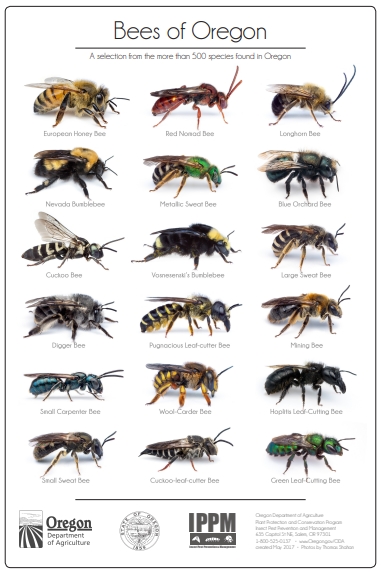
And the vast majority of them are solitary ground nesting bees. Meaning, they do not make hives for storing honey. But instead, they dig tunnels in the ground, or sometimes in old wood, lay eggs in each one, pack food in over the egg, and repeat, either in a new tunnel, or until the tunnel is full (see mason bees).
Side note: Meet the man on a mission to photograph every species of bumblebee in the Americas – a Herculean task! 8/30/26 Story via Amateur Photographer.
The bees in my beloved sleepy bee photos are a type of solitary ground-nesting Melissodes longhorn bee (unsure which exact species). Most honey bees get back to their hives even on hot days, so as to offload their pollen and nectar for food stores, and help keep the hive temperature regulated. The female longhorns are in their ground tunnels filled with eggs and provisions. The male longhorn bees will often sleep in flowers, as was probably the case that lucky evening last July when I found them. (It was 97 degrees F!)
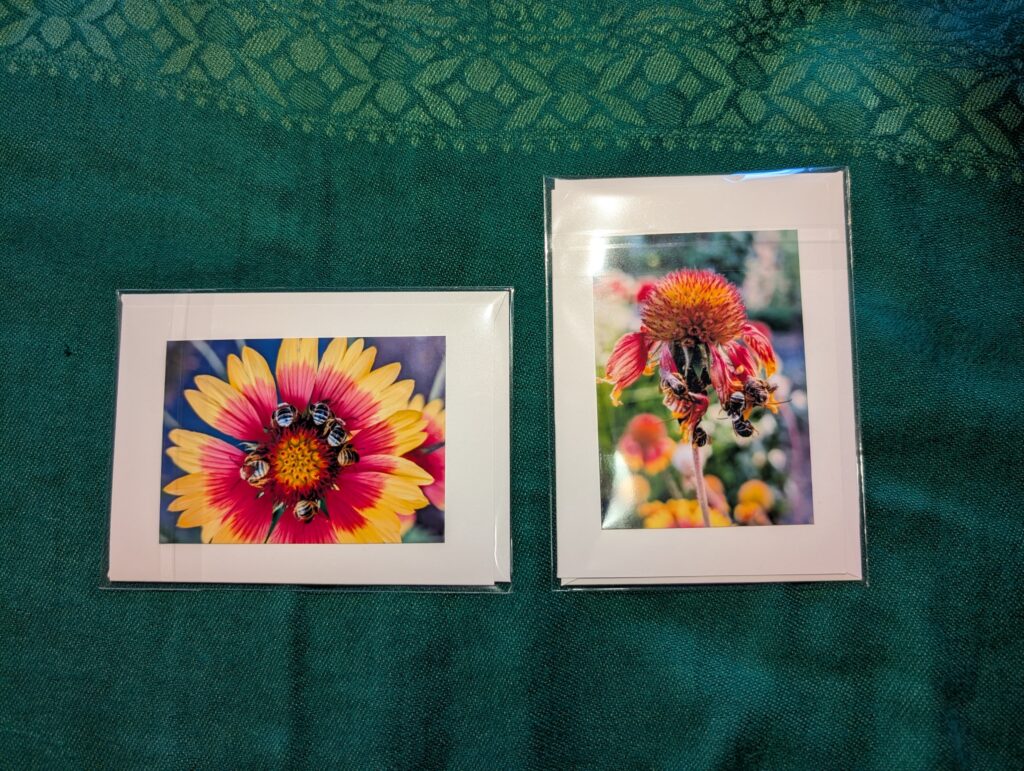
You can and will find several kinds of bees sleeping away in your flowers or garden foliage at the end of a hot summer day. Including bumblebees. They are very peaceful. But try to leave them bee – they are tuckered out!
Here are a couple of great films and videos on wild/native bees and honey bees you might enjoy:
- My Garden of A Thousand Bees (2021) – free on YouTube through October 2028 via PBS
- Secrets of the Bees (2026) – by National Geographic available on Hulu and Disney+ and I just spotted Episode 1 of the 2 free on YouTube recently! (I presume this will stay, and Episode 2 will arrive soon too.)
- Bee Wild! The Secret Life of Wild Honeybees (2026) Full documentary by the Free High-Quality Documentaries channel on YouTube
- Children of the Sun – Wild Bees / Full Documentary – Free High Quality Documentaries on YouTube 2023
- Intro to native bees and the Washington State Bee Atlas 2024
- True Facts: The Mystery of How Bees Build (2026) Ze Frank YouTube (Caution: PG, very tongue in cheek, mixing true facts with some raunchy humor and innuendo not all my find equally hilarious.) 16 minutes
- The Solitary Bees by Team Candiru on YouTube (2016) – 18 minutes
- How To Raise Leaf-Cutter Bees – Crown Bees on YouTube (2022) – 55 minutes
- A book, “Dancing with the Bees“, only available new in the UK. But I’ve found some used copies available in the US.
Feel free to share any other great videos or films you know about featuring bees. Let’s keep the bee-love going! See you around. – Jan
Last updated September 9, 2026